

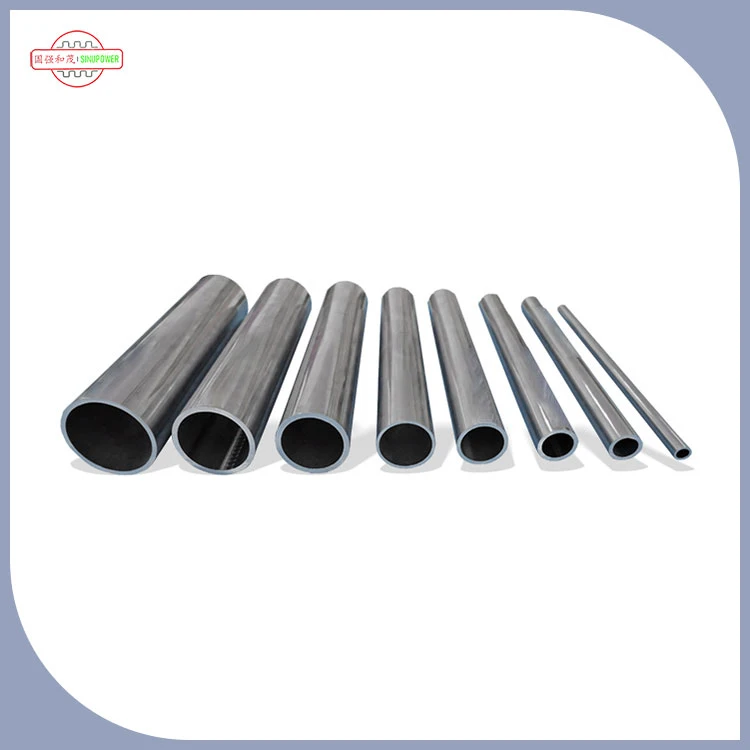
Heat transfer assemblies rely on geometrically optimized conduits to move refrigerants or coolants. The round condenser tube offers unique advantages in pressure resistance and flow dynamics. Its symmetrical cross-section ensures uniform stress distribution, making it suitable for high-pressure environments such as condenser units in automotive air conditioning or commercial chiller systems. Moreover, compatibility with brazing and mechanical joining processes gives round profiles an edge in assembly reliability.
When evaluating tubular geometries, round configurations exhibit superior burst strength compared to non-circular alternatives. This characteristic is vital for systems where refrigerants undergo phase changes, causing cyclic pressure spikes. Flow uniformity across the tube circumference reduces localized turbulence, enhancing overall heat transfer coefficients. Designers often select the round tube for applications demanding long-term creep resistance and minimal vibration-induced fatigue.
Advanced alloys and tempering processes directly affect thermal performance. Copper, brass, and aluminum-based round tubes are common, but next-generation formulations include micro-alloyed aluminum with magnesium or silicon. Such materials improve corrosion resistance while retaining formability. Surface treatments—like hydrophilic coatings or internal grooving—further augment heat rejection capacity. Manufacturers now apply precision drawing techniques to achieve consistent wall thickness, a prerequisite for predictable thermal modeling.
From electric vehicle battery thermal management to large-scale power station cooling, the round condenser tube proves indispensable. Below is a concise overview of primary application domains and performance priorities.
| Application Sector | Typical Operating Conditions | Key Performance Focus |
|---|---|---|
| Automotive Heat Exchange | High vibration, variable refrigerant flow, compact engine bays | Fatigue resistance, dimensional precision, leakage integrity |
| Commercial Air Conditioning | Continuous operation, moderate pressure, corrosive environments | Corrosion protection, thermal efficiency, long service life |
| Power Station Cooling | Large diameter requirements, high fluid throughput, outdoor exposure | Structural strength, weldability, fouling resistance |
| Building Door & Window Systems (thermal spacers) | Temperature gradient management, low maintenance | Dimensional stability, low thermal bridging |
In each scenario, the round tube must meet rigorous quality benchmarks, from metallurgical homogeneity to surface finish. Substandard tubes lead to efficiency losses or premature system failure, driving demand for proven suppliers with deep process knowledge.
Producing high-grade round tubing involves multiple stages: melting, casting, extrusion, drawing, and heat treatment. Among these, precision drawing controls outer diameter, inner diameter, and eccentricity. State-of-the-art lines incorporate in-line eddy current testing to detect micro-defects. Annealing cycles must be carefully managed to achieve the desired temper—too soft causes collapse under crimping; too hard risks cracking during bending. Leading facilities also implement statistical process control for wall thickness variation, holding tolerances within microns.
While the round condenser tube dominates many circuits, modern systems often integrate folded, rectangular, or D-shaped pipes alongside round sections. Hybrid heat exchangers may transition from round headers to flat tubes for fin bonding. This demands that a manufacturer possess versatile tooling and design support. Consequently, engineering teams with cross-sectional expertise can advise on optimal port shapes and wall distributions, reducing material usage without compromising burst limits.
End users in automotive and industrial cooling increasingly require full material traceability and certified mechanical properties. Any variance in the round tube's temper or chemical composition can alter brazing behavior, leading to joint leaks. To mitigate this, sophisticated mills implement lot-specific tracking and mechanical test reports. Additionally, environmental regulations restrict certain coatings and alloying elements, pushing manufacturers to develop chrome-free passivation and lead-free brass alternatives.
Traceability becomes even more critical for safety-related applications—for instance, refrigerant circuits in electric buses or data center cooling modules. A single defective tube may trigger warranty claims and reputational damage. Thus, procurement decisions now favor suppliers that demonstrate ISO quality management and continuous improvement cultures.
Within the landscape of precision tube manufacturing, Sinupower Heat Transfer Tubes Changshu Ltd. has established a solid reputation. The company develops and produces new energy precision pipes of varied profiles, including folded, rectangular, flat, round, D-shaped, and hollow glass aluminum spacers. These products serve automotive heat exchange, commercial air conditioning, power station cooling, and building window systems.
Sinupower was co-founded by Mr. Gao Qiang, an industry figure who previously worked for a world top 500 enterprise, together with experienced industry backbones. Since its establishment on May 6, 2018, the firm has operated for nearly five years, accumulating rich industry qualifications and management expertise in locations such as Beijing and Shanghai. The management team, with Mr. Gao at its core, applies this knowledge to ensure each round tube and other precision profiles meets stringent performance standards. Their integrated approach—from raw material selection to final dimensional inspection—delivers reliability that system engineers require.
Sinupower's product portfolio extends beyond conventional circular profiles. By mastering thickness variations, shape alterations, and dimensional fine-tuning, the company supports application-specific requirements. For instance, in motor vehicle condensers, a round tube with optimized inner groove geometry can increase heat rejection by a measurable margin without increasing outer diameter. Similarly, for HVAC applications requiring mixed tube types, Sinupower provides matched sets, minimizing assembly mismatches. This flexibility stems from in-house tool design and continuous investment in drawing benches and annealing furnaces.
Modern heat transfer components demand zero-defect policies. Sinupower implements rigorous testing protocols, including eddy current, pressure decay, and metallographic analysis. Each production lot undergoes verification of mechanical properties such as yield strength, elongation, and hardness. For the round condenser tube specifically, the firm measures ovality and surface finish to guarantee trouble-free insertion into fin stacks or header plates. Such systematic controls reduce rework costs for downstream fabricators.
Additionally, the company focuses on new energy applications, recognizing the shift toward electrified transportation and renewable cooling systems. Electric vehicle battery thermal plates, inverter coolers, and heat pump condensers increasingly rely on high-precision tubes with consistent inner diameters. Sinupower's experience in aluminum and copper-based alloys positions it to serve these emerging markets, where lightweight construction and corrosion resilience are paramount.
Engineering support distinguishes a component supplier from a transactional vendor. Sinupower’s technical staff collaborates with clients during the design phase, advising on wall thickness optimization and bend radius limitations. This pre-production engagement helps avoid costly tooling changes later. Moreover, because the company produces both round tubes and non-round profiles (flat, folded, D-shaped), customers can consolidate sourcing, simplifying logistics and quality audits.
The management's background in global industrial environments brings a systematic approach to continuous improvement. Statistical process control charts monitor critical parameters like diameter tolerance and surface roughness. Corrective actions are documented and reviewed in management meetings, ensuring that non-conformance rates remain minimal. For high-volume orders, this consistency translates into predictable assembly line performance.
As energy efficiency regulations tighten worldwide, the role of high-performance tubing will only expand. Heat exchangers with enhanced surface geometries or internal enhancements can reduce refrigerant charge and improve seasonal efficiency. The round tube, when combined with micro-fins or rifled inner surfaces, achieves higher Nusselt numbers, meaning more heat transfer per unit length. Manufacturers like Sinupower are well positioned to adopt new forming technologies, such as laser welding or flow-forming, to produce thinner yet stronger tube walls.
Sustainability also drives changes: recyclable materials and low-carbon production processes are becoming differentiators. Sinupower’s location in Changshu, an industrial hub with access to recycled aluminum and copper feedstocks, allows it to reduce primary metal consumption. The company’s nearly five years of operation, built on prior decades of management experience, creates a stable foundation for scaling green manufacturing practices. In turn, clients achieve their own environmental targets without sacrificing thermal performance.
Selecting a round condenser tube supplier involves more than comparing price lists. Metallurgical knowledge, process control, traceability, and engineering collaboration define long-term value. Sinupower Heat Transfer Tubes Changshu Ltd., through its foundation by industry veterans and commitment to precision, exemplifies these qualities. The company’s ability to produce diverse profiles—round, folded, rectangular, flat, D-shaped, and hollow glass aluminum spacers—serves a broad spectrum of thermal applications. With a management team seasoned in Beijing and Shanghai markets, Sinupower continues to strengthen its position as a reliable partner for automotive, commercial AC, power station cooling, and building systems.
For engineers seeking consistent quality and technical support, the round tube remains a cornerstone component. As the industry advances toward more compact and efficient designs, partnerships with dedicated manufacturers will determine success. Sinupower’s focused approach, backed by real-world experience and modern facilities, ensures that every tube—regardless of shape—fulfills its critical role in the heat transfer chain.


