

Sinupower Heat Transfer Tubes Changshu Ltd. is closely associated with the development of High Strength Stainless Steel Tubes, especially as cold work (strain hardening) continues to shape how modern tubular materials achieve durability and stability in demanding environments. Understanding how mechanical deformation improves performance helps explain why these tubes behave so reliably under pressure, temperature shifts, and long-term service conditions. The concept of strain hardening is not just a technical detail—it is a practical pathway that transforms ordinary stainless steel into a far more resilient engineering material.
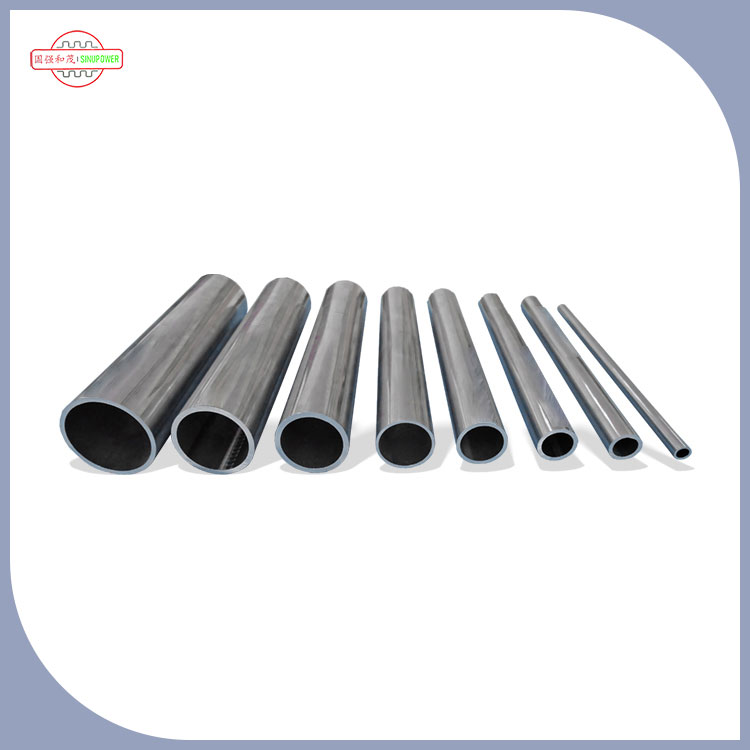
Cold work, often referred to as strain hardening, is a process where stainless steel is deformed at room temperature. Unlike heat-based strengthening methods, this approach relies purely on mechanical force. When stainless steel tubes are rolled, drawn, or pressed into shape, internal structural changes begin to occur immediately.
In simple terms, the metal "remembers" the stress applied to it. As deformation increases, the internal structure becomes more resistant to further change, which is a key reason why High Strength Stainless Steel Tubes gain improved mechanical performance without altering their chemical composition.
During cold work, the atomic structure of stainless steel does not move freely. Instead, imperfections in the crystal lattice—known as dislocations—begin to multiply and interact. These interactions make it increasingly difficult for the material to deform further.
The result is a gradual increase in hardness and tensile strength. However, this also reduces ductility, meaning the material becomes stronger but slightly less flexible.
Dislocations act like microscopic roadblocks inside the metal structure. As more dislocations form, they begin to interfere with each other's movement. This congestion effect is what drives strain hardening.
In practical terms:
- More dislocations = higher resistance to deformation
- Higher resistance = increased strength
- Controlled deformation = optimized tube performance
The improvement in stainless steel tube strength is not visible to the naked eye, but it is deeply rooted in microstructural evolution.
One of the most important effects of cold work is the rapid rise in dislocation density. As stainless steel is shaped into tubes, these dislocations accumulate and entangle. This makes the internal structure more rigid.
Although grain size does not necessarily become smaller, grains become elongated and distorted in the direction of deformation. This alignment contributes to directional strength, especially in tubing applications where pressure is often applied along specific axes.
The combined effect results in High Strength Stainless Steel Tubes that maintain stability even when exposed to cyclic loading or fluctuating operational conditions.
Strain hardened stainless steel tubes are widely valued because their performance advantages are not limited to laboratory conditions. They show consistent behavior in real environments where multiple stress factors exist simultaneously.
Typical performance improvements include:
- Enhanced resistance to internal pressure
- Improved fatigue life under repeated stress cycles
- Better structural stability at moderate temperature variations
- Reduced risk of deformation under mechanical load
These characteristics make the material suitable for systems where reliability is more important than extreme flexibility.
| Property Aspect | Annealed Stainless Steel Tubes | Cold Worked Stainless Steel Tubes |
| Tensile Strength | Moderate | Significantly higher |
| Yield Strength | Lower | Higher |
| Ductility | High | Reduced but controlled |
| Hardness | Moderate | Increased |
| Resistance to Deformation | Lower | Strong |
| Structural Stability | Stable | Highly stable under load |
This comparison highlights how cold work fundamentally changes the behavior of stainless steel, creating High Strength Stainless Steel Tubes that perform differently from their softer counterparts.
Cold-worked stainless steel tubes are widely applied in systems where mechanical stability and corrosion resistance must work together.
Common usage environments include:
- Automotive heat exchange systems where vibration and thermal cycling coexist
- Commercial air conditioning frameworks requiring long-term structural consistency
- Power station cooling circuits exposed to continuous fluid pressure
- Building systems where tubing must retain shape under mechanical stress
In each of these environments, the combination of strength and corrosion resistance becomes essential for stable operation.
Producing stainless steel tubes with predictable strength requires careful control over each deformation stage. Variations in drawing speed, pressure levels, and intermediate annealing can significantly influence final mechanical behavior.
Sinupower Heat Transfer Tubes Changshu Ltd. integrates structured processing systems supported by a wide range of equipment including drawing machines, annealing furnaces, welding production lines, and precision forming tools. This allows each batch of tubing to maintain consistent mechanical characteristics.
Quality control processes such as dimensional verification and mechanical property testing ensure that the transformation into Stainless Steel Tubes remains stable across different production cycles. Certification systems including ISO9001:2015 and IATF16949 further support process reliability and environmental compliance.
Even with advances in material science, strain hardening remains one of the most efficient ways to enhance stainless steel performance without changing its chemical makeup. It offers a balance between simplicity and effectiveness, allowing mechanical properties to be tailored through controlled deformation.
Another advantage is predictability. Unlike alloy modification, cold work allows engineers to adjust strength levels through measurable processing steps, making it easier to design tubing systems with defined performance thresholds.
Cold work (strain hardening) provides a clear and practical explanation for how stainless steel tubing evolves from a ductile material into a high-performance structural component. Through controlled deformation, internal dislocation density increases, grain structures adapt, and mechanical resistance improves in a measurable way. These changes form the foundation of modern High Strength Stainless Steel Tubes, which are widely used in demanding thermal and mechanical environments.
Within this context, Sinupower Heat Transfer Tubes Changshu Ltd. continues to apply structured engineering processes and precision equipment to support the development and production of stainless steel tube solutions, including Stainless Steel Tubes, aligning material behavior with real-world application needs in automotive, energy, and building system environments.


