

Sinupower has long focused on precision aluminum tube systems, and the role of the Evaporator Header Pipe is central in how modern cooling circuits manage multi-tube refrigerant flow in compact systems.
In many refrigeration and air-conditioning layouts, efficiency depends less on a single component and more on how multiple small tubes work together. Among them, the Round Condenser Tube acts as a gathering and distribution hub, connecting several evaporator tubes into a unified flow path. Understanding this structure helps explain why cooling performance can remain stable even under changing load conditions.
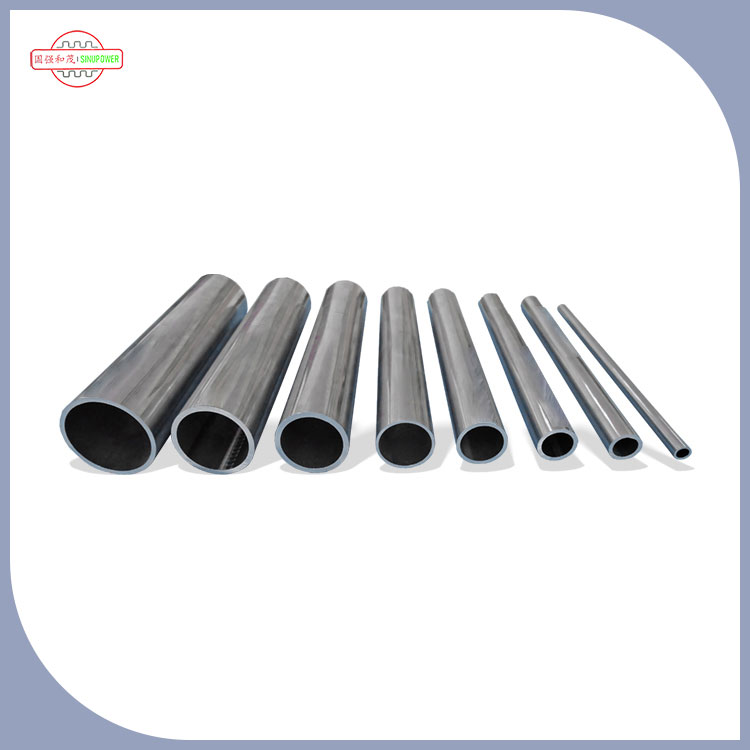
In a typical evaporator assembly, refrigerant enters through a controlled inlet and splits into multiple parallel tubes. These tubes absorb heat from surrounding air or liquid, gradually turning refrigerant from liquid to vapor.
However, without a structured collection system, vapor and remaining liquid would exit unevenly. This is where the header structure becomes essential.
A well-designed Round Condenser Tube performs three key roles:
- Collects refrigerant from multiple evaporator tubes
- Balances pressure differences across tube branches
- Stabilizes flow before sending refrigerant downstream
This balancing function is especially important in systems where temperature loads are not uniform.
The working principle of a header system is relatively straightforward but mechanically refined. Each evaporator tube feeds into the header at a calculated angle and spacing. Inside the header, flow paths merge gradually instead of abruptly, reducing turbulence.
When refrigerant exits the evaporator tubes, it may have different vapor-liquid ratios depending on localized heat absorption. The header equalizes these differences by:
- Slowing down high-velocity vapor pockets
- Allowing residual liquid droplets to settle or redistribute
- Creating a more uniform mixture before compression stage
In this process, the Evaporator Header Pipe is not just a collector—it acts as a stabilizer for phase consistency.
Modern header systems are not simply hollow pipes. Their geometry is carefully tuned based on system capacity, refrigerant type, and operating pressure range.
Below is a simplified comparison of structural factors and their functional impact:
| Design Factor | Engineering Purpose | System Impact |
| Tube inlet spacing | Ensures even refrigerant entry | Reduces local flow imbalance |
| Internal diameter gradient | Controls velocity changes | Improves phase mixing stability |
| Wall thickness variation | Supports pressure tolerance | Enhances operational safety |
| Material selection | Handles thermal cycling | Extends service stability |
| Connection geometry | Reduces turbulence zones | Improves overall efficiency |
These design features directly influence how effectively a header can manage multi-tube flow behavior.
Sinupower Heat Transfer Tubes Changshu Ltd. applies precision forming techniques such as drawing, punching, and controlled annealing to achieve stable geometric consistency in aluminum alloy tube systems used in such applications.
In refrigeration and HVAC systems, uneven refrigerant distribution can lead to:
- Reduced heat exchange efficiency
- Localized freezing or overheating
- Increased compressor workload
- Unstable system cycling
The Round Condenser Tube addresses these risks by ensuring that refrigerant leaving multiple tubes does not create imbalance at the collection point. Even small inconsistencies in flow can compound across large systems, making the header an important structural equalizer.
Multi-tube evaporator structures using header pipes are widely found in:
- Automotive thermal management systems
- Commercial air-conditioning units
- Power station cooling modules
- Building climate regulation systems
- Compact heat exchanger assemblies
In each environment, system constraints differ, but the function of the header remains consistent: organize distributed flow into a predictable output stream.
Despite its simple appearance, designing an efficient header system involves several technical challenges:
1. Uneven Phase Distribution
When refrigerant enters from multiple tubes, vapor and liquid separation can vary significantly. If not controlled, this leads to inconsistent downstream flow behavior.
2. Thermal Expansion Effects
Repeated heating and cooling cycles can slightly deform tubing systems, changing internal flow balance over time.
3. Space Constraints
In compact systems, headers must manage multiple connections within limited installation space without creating sharp bends or pressure losses.
4. Material Fatigue
Long-term exposure to pressure fluctuations requires materials that maintain structural stability without micro-cracking or deformation.
These challenges explain why precision manufacturing and controlled processing routes are essential in modern header components.
The performance of an Evaporator Header Pipe is closely linked to the quality of the base tube material and forming accuracy. In advanced production environments, processes such as:
- Multi-stage drawing
- Controlled annealing cycles
- High-precision welding line integration
- Dimensional calibration
are used to ensure that each pipe segment maintains consistent internal geometry.
Sinupower Heat Transfer Tubes Changshu Ltd. operates with a broad range of forming and processing equipment, enabling the production of folded, rectangular, flat, round, and D-shaped tubes that can be integrated into complex thermal systems.
This flexibility supports customized structural layouts where evaporator headers must match specific design requirements.
A stable refrigerant collection structure contributes to system reliability in several ways:
- Reduces pressure fluctuations at the compressor inlet
- Maintains consistent evaporator output temperature
- Improves responsiveness under load changes
- Minimizes uneven frosting in heat exchange surfaces
These improvements are not always visible in isolation, but they become significant in long-term operation, especially in systems with variable cooling demand.
To better understand how the Round Condenser Tube works in practice, the following simplified overview highlights its functional sequence:
- Multiple evaporator tubes receive refrigerant
- Phase change occurs unevenly across tubes
- Header collects mixed refrigerant streams
- Internal geometry smooths flow differences
- Stabilized refrigerant exits toward next cycle stage
This sequence illustrates why the header is considered a balancing component rather than just a connecting part.
In modern thermal management systems, the Evaporator Header Pipe plays a quiet but essential role in ensuring that multi-tube evaporators function as a unified system rather than independent channels. Its effectiveness depends on structural precision, material stability, and controlled flow design. Products such as Sinupower Round Condenser Tube reflect how engineering focus on flow consistency continues to shape refrigeration and heat exchange applications across different industries.


