

Sinupower Battery Cooling Plate Tubes are helping advance battery thermal management by improving coolant circulation and maintaining stable operating temperatures in modern energy systems.
As electric vehicles (EVs), energy storage systems, and other battery-powered technologies continue to develop, battery safety and performance have become major industry concerns. During charging and discharging, battery cells naturally generate heat. If this heat cannot be removed effectively, it may reduce battery efficiency, shorten service life, and affect overall system reliability.
A well-designed cooling system works as the "temperature manager" of a battery pack. It controls heat movement, prevents extreme temperature changes, and allows batteries to operate within a suitable range. Among the key components supporting this process, cooling tubes play an important role by creating a pathway for coolant circulation.
Sinupower Heat Transfer Tubes Changshu Ltd. focuses on developing precision tubes for new energy applications, including various designs used in battery thermal management systems. With experience in aluminum alloy precision tube production and heat transfer technology, the company provides solutions designed for different structural requirements in modern battery systems.
The working principle of a battery cooling system is based on continuous heat transfer. When battery cells produce heat, the cooling medium absorbs this heat and carries it away through specially designed channels.
Battery Cooling Plate Tubes are usually integrated into the battery pack structure. A liquid coolant flows through the internal passages of the tubes, absorbing heat from areas close to the battery cells. The heated coolant then moves toward a cooling unit, where the heat is released before the coolant returns to the circulation loop.
This process continues repeatedly during battery operation, creating a stable temperature control cycle.
| Cooling Process Step | Function |
| Heat generation | Battery cells produce heat during charging and discharging |
| Coolant absorption | Liquid coolant captures excess heat through contact with cooling channels |
| Heat transfer | Tubes guide the heated coolant away from battery areas |
| Cooling recovery | The cooling system reduces coolant temperature |
| Continuous circulation | The cooled medium returns to maintain battery temperature balance |
This simple but effective process helps reduce temperature differences between battery cells, improving system consistency.
Not all cooling tubes provide the same performance. Battery systems require components that combine efficient heat transfer, structural strength, and reliable long-term operation.
The shape, thickness, and internal structure of cooling tubes directly influence coolant flow and heat dissipation efficiency. For example, flat tubes can provide a larger contact surface area, while specially shaped tubes can better match limited installation spaces inside battery packs.
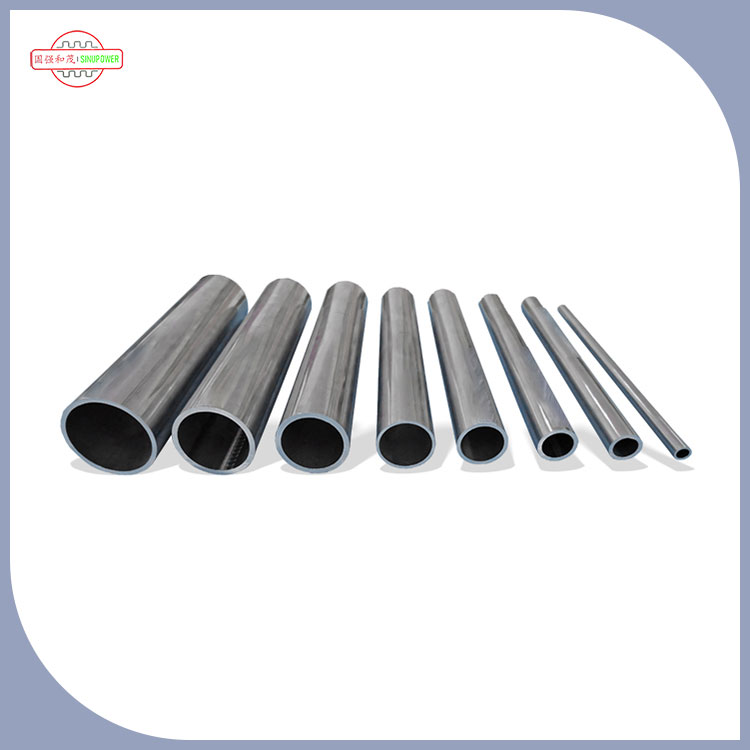
Sinupower develops various precision pipe structures, including folded pipes, rectangular pipes, flat pipes, round pipes, and D-shaped pipes. These designs allow engineers to select suitable solutions based on different battery layouts and application environments.
| Design Factor | Impact on Battery Cooling |
| Tube shape | Determines installation flexibility and contact area |
| Material selection | Affects thermal conductivity and durability |
| Wall thickness | Influences strength, weight, and heat transfer speed |
| Internal channel design | Controls coolant flow efficiency |
| Manufacturing accuracy | Ensures stable assembly and reliable operation |
For new energy applications, aluminum alloy is widely used because it offers a good balance between lightweight construction, corrosion resistance, and thermal performance.
Battery thermal management faces several practical challenges. Different vehicles and energy systems may have limited installation space, different power requirements, and varying operating conditions.
One common issue is uneven temperature distribution. In a large battery pack, some cells may become hotter than others during operation. This temperature imbalance can influence battery performance and aging speed.
Efficient cooling tube structures help create more uniform heat removal across the battery system. By improving coolant circulation paths, the system can reduce hot spots and maintain a more stable operating environment.
Another challenge is balancing cooling performance with lightweight design. Electric vehicles require components that provide strong performance without adding unnecessary weight. Precision aluminum tubes help achieve this balance by supporting efficient heat exchange while maintaining a compact structure.
Although electric vehicles are one of the main application areas, Battery Cooling Plate Tubes technologies are also expanding into other fields.
Energy storage systems, industrial equipment, and renewable energy applications increasingly depend on reliable battery temperature management. Large-scale battery installations often operate for long periods, making effective cooling essential for maintaining operational stability.
The demand for advanced thermal management solutions continues to increase as industries move toward cleaner energy technologies. Components such as cooling tubes are becoming increasingly important in supporting safer and more efficient battery systems.
Founded in 2018, Sinupower Heat Transfer Tubes Changshu Ltd. specializes in research, development, and production of precision tubes for heat transfer applications. The company has established quality management systems including ISO9001:2015, IATF16949, ISO14001:2015, and ISO45001:2018 certifications.
With advanced production equipment covering welding lines, sawing machines, drawing machines, annealing furnaces, and related processing facilities, Sinupower is capable of producing various aluminum alloy precision tubes according to application requirements.
The company also continues to improve product design through technical development and accumulated industry experience. Its cooperation with companies such as Sanhua, Danfoss, and Pankl reflects its involvement in high-standard heat transfer application fields.
As battery systems become more powerful and compact, thermal management technology will continue to evolve. Future cooling solutions are expected to focus on higher efficiency, better integration, and improved reliability.
Manufacturing accuracy will remain a key factor because even small differences in tube structure can influence coolant distribution and overall system performance. More customized designs will also become common as different industries develop specialized battery platforms.
Effective temperature control is not only about removing heat but also about creating a safer and more stable environment for battery operation. This makes precision cooling components an important foundation for the continued growth of new energy technologies.
Understanding how coolant moves through a battery system helps explain why carefully engineered components are essential. Sinupower Heat Transfer Tubes Changshu Ltd. continues to support new energy development through advanced Battery Cooling Plate Tubes and precision heat transfer tube solutions designed for modern battery thermal management needs.


